95% of the cosmic mass is not mystical dark energy or undetected quantum particles, but eternal classical black hole gravitation within an infinite, self-renewing Multiverse.
Golden points: luminous stars (~5%). Blue concentric vectors: stochastic primordial black hole halo (~95%) maintaining flat galactic rotation.
The standard cosmological model ($\Lambda\text{CDM}$) attributes 95% of cosmic mass-energy to entities that have never been directly detected in laboratory experiments.
Quantum field theory predicts a vacuum energy density diverging from astronomical observations by 120 orders of magnitude ($10^{120}$) — the largest discrepancy in theoretical physics.
Neither the Large Hadron Collider (CERN LHC) nor deep cryogenic detectors (XENONnT, LUX-ZEPLIN) have detected a single weakly interacting massive particle or supersymmetric candidate.
SGDM introduces no unproven entities: the dark sector is explained by real relativistic compact bodies (black holes) and classical Einsteinian geometry.
Instead of fragmenting nature into three decoupled phenomenological parameters, SGDM unifies cosmology into a self-consistent gravitational system.
From the exact topological derivation of the fine-structure constant \(1/\alpha = 137.035999\dots\) and the Fermilab muon anomaly to the nature of Dark Matter (95%) and particle lifetimes spanning 33 orders of magnitude from standing-wave geometry \(B = 2^p + D^2\).
Standard Physics: Free input parameter in QED. No derivation exists (R. Feynman: "a magic number that comes to us with no understanding").
Standard Physics: Unresolved \(5.1\sigma\) discrepancy with Standard Model calculations in Muon g-2 experiment (2021–2023).
Standard Physics: Introduced via arbitrary Yukawa couplings in Higgs mechanism. Reason for 1836.15 is unknown.
Standard Physics: 4% discrepancy between muonic and electronic hydrogen recognized as unresolved puzzle (CREMA 2010–2024).
Standard Physics: Experiments proved that 3 quarks account for only ~30% of proton spin. Where the remaining 70% resides was unknown since 1987.
Standard Physics: Gell-Mann — Okubo formula and Lattice QCD fit quark masses and parameters manually.
Standard Physics: Weizsäcker liquid drop model fits binding curve empirically. Why peak is at Fe-56 is unknown.
Standard Physics: Decay times from \(10^{-24}\text{ s}\) to \(10^9\text{ yrs}\) parameterized via CKM matrix elements.
Standard Physics: Rydberg — Ritz formula relies on empirical quantum defect \(\delta_l\) fitted from spectra.
Standard Physics: "Cosmic Coincidence Problem" (P.J. Peebles). No explanation (anthropic principle evasion).
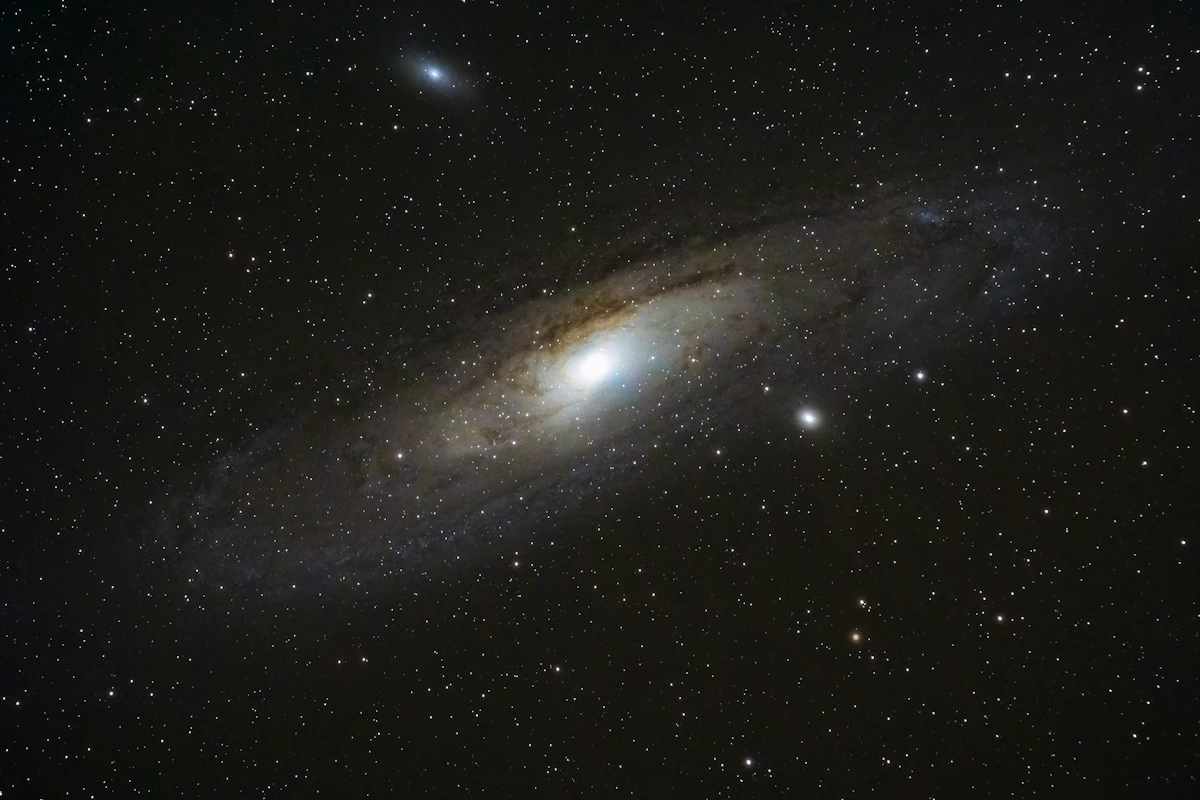
In the 1970s, Vera Rubin demonstrated that outer stars in spiral galaxies do not follow Keplerian decline ($v \propto R^{-1/2}$), but rotate at a flat velocity of 220 km/s.
Total luminous baryonic mass in the disk, bulge, and gas is $M_{\text{bar}} \approx 5.5 \times 10^{10} M_\odot$. Without massive extended halo support, the disk would be centrifugally torn apart.
A stochastic cloud of stable primordial black holes creates a density profile $\rho(r) \propto 1/r^2$, yielding linear mass growth $M(r) \propto r$ and flat rotation $v(r) = \text{const}$.
The central supermassive black hole ($4.3 \times 10^6 M_\odot$) serves as the primary barycenter around which early baryonic gas collapsed.
Infinite density represents mathematical breakdown. SGDM introduces a finite physical core of density $\rho_0 = \text{const}$.
For a cluster-scale Mega-Black Hole ($10^{20} M_\odot$): event horizon $R_s \approx 31\text{ million light-years}$, while the core is smaller than Venus's orbit ($0.36\text{ AU}$). Over 99.99999999999999999% of interior space is pure vacuum.
Nuclear topology, gravitational nuclear force ($10^4-10^6\text{ N}$) and the origin of mechanical and optical material properties.
Section 3: Encounter rates, hydrodynamic spin-up to $a^* \to 1$, kimberlite diatremes and shock mantle mineralogy.
The Big Bang is not an ex-nihilo singularity, but the centrifugal disruption of a maximally spinning Kerr core ($a^* \to 1$).
Stars burn, planets and life emerge (~5%). Primordial black holes (~95%) anchor galactic structural integrity.
Stellar fuel depletes. Remnant stars and intermediate black holes merge into supermassive hubs.
All domain mass collapses into a single Domain Mega-BH, spinning up to the relativistic Kerr barrier $a^* \to 1$.
Centrifugal force exceeds gravity ($a_{\text{cent}} \ge g_{\text{grav}}$). The horizon ruptures — creating an expanding daughter universe!
The question of a physical center divides relativistic cosmology into two distinct paradigms: the mathematically homogeneous metric-stretching framework ($\Lambda\text{CDM}$) and the materialistic dynamical centrifugal ejecta model in an open Multiverse (SGDM).
| Criterion / Question | Standard Model ($\Lambda\text{CDM}$) | SGDM Model (Yu. A. Chesnokov) |
|---|---|---|
| 1. Physical 3D Center | None (space expands everywhere equally; only local observers are trivially centered). | Physically Exists ($O_1$) — the origin point of the Kerr core $\rho_0$ centrifugal disruption. |
| 2. Big Bang Mechanism | Superluminal metric expansion (inflation of scalar field from a point singularity). | Relativistic centrifugal disruption of Kerr core at $v_{\text{eq}} \to c$ ($a^* \to 1$, invariant $K \equiv 1.04$). |
| 3. Large-Scale Anomalies | Random statistical fluctuations in CMB multipoles and peculiar velocity noise. | Direct Center & Axis Markers: CMB "Axis of Evil" $\implies$ axis $\vec{J}_0$; Dark Flow $\implies$ offset toward $M_2$. |
| 4. Milky Way Location | Arbitrary point in a homogeneous continuum. | Triangulated: $r_{\text{MW}} \approx 2.50\text{ Gly}$ ($766.5\text{ Mpc}$) from origin $O_1$, inclined to equator at $\beta \approx 6^\circ - 10^\circ$. |
| 5. Boundary & Environment | Closed isolated system accelerated by mysterious "dark energy". | Open Domain: tidal gravitational expansion driven by neighboring universes across Lagrange saddle $\mathcal{S}_L$. |
Prior to explosion, all $1.2 \times 10^{80}$ gravitons of core $\rho_0$ were coherently polarized along $\vec{J}_0$. Centrifugal disruption ($t=0$) imparts a shared spin vector ($\vec{s} \parallel \vec{J}_0$) to equatorial PBHs and protogalaxies, generating the Supergalactic Plane and explaining SDSS spiral parity asymmetry and the CMB "Axis of Evil".
Theoretical predictions of Yuri A. Chesnokov's model have received direct empirical confirmation in space observatory datasets: the Universe possesses a physically materialized rotation axis and strict coaxiality of angular momentum.
Materialization of the $Z$ polar axis by the diametrical pair IC 1101 (+Z) — Phoenix A (-Z) with momentum balance ($\sum \vec{P}_z \equiv 0$) and $\Theta_{O_1} \approx 180^\circ$ (physical resolution of CMB "Axis of Evil").
Spatial alignment of rotation vectors and plane parallelism in "Milky Way — IC 1101 — Phoenix A" (mean tilt $\Delta\theta \approx 6.0^\circ$) as angular momentum conservation $\vec{J}_0$.
In the SGDM framework, reaching the speed of light at the equator $v_{\text{eq}} \equiv \Omega \cdot R \equiv c$ serves as an invariant trigger of centrifugal disruption across all graviton-bearing systems — from the microscopic proton ($N_{\text{grav}} = 1$) to supermassive black holes and multiverse Mega-domains:
| Micro- & Macro-System | Gravitons $N_{\text{grav}}$ | System Radius $R$ | Equatorial Speed $v_{\text{eq}}$ | Period $T_{\text{rev}}$ | Physical Outcome at $v \to c$ |
|---|---|---|---|---|---|
| 1. Proton ($^1\text{H}$, nucleon) | $1$ | $0.84\text{ fm}$ | $c$ | $1.8 \times 10^{-23}\text{ s}$ | Quantum quark confinement barrier ($uud$) |
| 2. Gold Nucleus ($^{197}\text{Au}$) | $197$ | $7.0\text{ fm}$ | $c$ | $1.5 \times 10^{-22}\text{ s}$ | Regge limit: centrifugal fission at extreme spin |
| 3. Micro-BH (Dark Matter) | $10^{44}$ | $50\text{ nm}$ | $c$ | $1.0 \times 10^{-15}\text{ s}$ | Femtosecond centrifugal disruption of micro-horizon |
| 4. Stellar BH ($10\ M_\odot$) | $10^{58}$ | $20\text{ km}$ | $c$ | $0.4\text{ ms}$ | Relativistic jet shedding of accretion disk |
| 5. Mega-BH (Our Universe) | $1.2 \times 10^{80}$ | $36.2\text{ AU}$ | $c$ | $31.5\text{ hours}$ | BIG BANG: Superdisk genesis and cosmic expansion! |
| 6. Mega-Attractor ($5\ M_1$) | $6.0 \times 10^{80}$ | $61.9\text{ AU}$ | $c$ | $53.9\text{ hours} \ (2.25\text{ d})$ | Super-Big Bang of massive multiverse domain |
At the extreme Kerr barrier ($a^* = 1$), the event horizon radius $R = \frac{GM}{c^2}$ and the mass of the incompressible core $M = \frac{4\pi}{3}\rho_0 R^3$ satisfy an exact relativistic identity:
Radius $R$ and Mass $M$ cancel out completely! Equatorial centrifugal pressure exceeds binding tensile stress by exactly +4% for any black hole core.
1. Scale-Independent Stability: From dwarf domains ($0.1\,M_1$, $R=16.8\text{ AU}$) to our Universe ($M_1$, $R=36.2\text{ AU}$) and mega-attractors ($10\,M_1$, $R=78.0\text{ AU}$), the ratio of forces at $v_{\text{eq}} \to c$ remains invariant at $K \equiv 1.04$.
2. Absolute Big Bang Trigger: Nature prevents naked singularities ($a^* > 1$). Once infall spins the equator to $v_{\text{eq}} \to c$, the $+4\%$ centrifugal excess inevitably ruptures the horizon, initiating the Big Bang and seeding a new cosmic supercycle!
Our universe is surrounded by an infinite number of neighboring domains. External gravitational pull induces isotropic radial tidal stretching of our local volume.
SGDM resolves core observational paradoxes where the standard model fails.
| Astrophysical Observation | Conflict in $\Lambda\text{CDM}$ | SGDM Resolution |
|---|---|---|
| Early Supermassive BHs (JWST, $z > 10$) | Insufficient time (<400 Myr) to grow from gas. | Relict massive black holes captured from older neighboring domains. |
| Gravitational Wave Background (NANOGrav 2023) | Requires unphysically dense binary populations. | Integrated stochastic noise from ongoing black hole mergers across the Multiverse. |
| Cosmic Dark Flow (~1000 km/s toward Centaurus) | Dismissed as an observational anomaly. | Direct dipole gravitational gradient from an Ancient Mega-Black Hole domain. |
| SGDM 3D Interferometer (2026 Patent) | 2D interferometers (LISA, TianQin) cannot resolve the complete 3D curvature tensor. | 3D tetrahedron (GEO + Polar orbit) directly calibrated to the Universal Polar Axis (Axis of Evil). Explore patent ➔ |
Verify the mathematics yourself: calculate Schwarzschild horizons, core $\rho_0$ scaling, Kerr centrifugal disruption, and Multiverse tidal acceleration.
Comparison of horizon $R_s \propto M$ and physical core radius $R_{\text{core}} \propto M^{1/3}$
For massive black holes, horizon radius $R_s$ scales linearly while core radius grows as cube root, leaving 99.99999...% of the volume as pure vacuum.
Full academic treatises, numerical protocols, and patent descriptions under official permanent ORCID: 0009-0008-5869-0047 | DOI: 10.5281/zenodo.23427659 (CERN / OpenAIRE, Geneva).
3D torus electron ($137\,\lambda_C$), Chesnokov series for $1/\alpha \equiv 137.035999177$, and tidal identity $\Lambda$.
Transition $1s \to 2p$, asymmetric torus $271\text{--}274\text{--}276$, $48\text{ cm}$ wave train launch at $E=0$, and $\sin^2\theta$ lobes.
4-rotor drive, eliminating $1,324\text{ t}$ fuel ($22\text{ tank cars}$), $99.88\%$ energy savings, and 3D tacking dynamics.
Continuous sinusoidal thrust ($F \sim \sin^2\omega t$), $\text{Jerk} \equiv 0$, 5-motor assembly (58 kW mean), 1.0 t to Mars in 90 days.
Postulate #4, Patent #6 diurnal polar testbed with viscous dampers, sidereal drift (23h 56m), and $\pm 4.75\%$ orbital ellipse.
32 qudits with 256 phases ($2^{256}$ state space), optical ALU (1 ps), recirculating memory (1 ms) at +20°C without helium.
Massive graviton $M_g \sim 10^{-68}\text{ kg}$, nuclear topology $N_{\text{grav}} = A$, gravitational nuclear force ($10^4-10^6\text{ N}$), nuclear classification, and material stiffness.
Complete theoretical synthesis: Multiverse ontology, progenitor graviton ($M_g \sim 10^{-68}\text{ kg}$), core $\rho_0$ ($36\text{ AU}$), and superluminal vacuum ($5.2\times 10^6\,c$).
Canonical set of 12 fundamental postulates: incompressible core $\rho_0$, Kerr limit $a^* \to 1$, cosmic ellipsoid, and equations.
Physical proof of cosmic domain mass completeness ($10^{23} M_\odot$) and the 3D spin-damping governor ($a^* \propto N^{-3/2}$).
English two-column scholarly preprint formatted for international peer review and research dissemination.
Complete 7-section paper + 20 FAQ appendix with author credentials in Word DOCX format.
Accessible general-audience introduction to the 95% dark mass problem and cyclic multiverse.
Physical-Technical Faculty of DSU (Alumnus 1984), Independent Physicist
Stochastic Gravitational-Dynamic Multiverse Model (SGDM)
@article{chesnokov2026sgdm,
author = {Chesnokov, Yury Alexandrovich},
title = {Stochastic Gravitational-Dynamic Multiverse Model (SGDM): A Unified Paradigm for the Dark Sector, Cyclic Gravitational Evolution, and the Origin of Cosmological Expansion},
journal = {Preprint},
year = {2026},
url = {https://multiverse.asistent-aiart.ru/en/},
note = {Physical-Technical Faculty of DSU Alumnus (1984)}
}